How can plants attract pollinators?
Cycads found in central Australia rely on thrips for pollination. The thrips are attracted by the scent, which then use to manage insects for male and female cones. Photo: M Bulbert © Australian Museum.
Just provide nectar can not guarantee that insects will come to a facility or transferring pollen to pollen recipients of the same species. For this reason, plants use visual and olfactory cues to attract and direct insects.
The scent is an effective way to attract pollinators. For example, strongly scented flowers tend to be visited by beetles and flies, while bees and butterflies visit fragrant flowers. It is also an effective way to manage pollinators to the pollen receivers.
Cycads from Australia internal use scent to lure thrips for pollination. Thrips are very small insects that can not carry much pollen grains, so the plant needs to attract a large number of them. A male Cycad cone laden with pollen will send a strong and pungent scent that will attract as many as 50 000 thrips. Female cones also emit an odor when they are ready to receive pollen, which then attracts the pollen-laden thrips.
Scent can also be used to fool the insects to be pollinators. The Corpse Flower of Indonesia uses a pungent smell of rotting meat to attract insects Carrión. The Australian Broad-lipped Orchid mimic the smell and also the emergence of a female Thynine wasps. This idiots male wasps in trying to mate with the flower that is pollinated in the process. www.bugwise.net.au
Saturday, December 20, 2008
How can plants attract pollinators?

How does flower shape affect pollinators?
How does flower shape affect pollinators?
A bee using its long tongue (Silhouette through the side of the flower) to access the nectar at the base of a flower with a long tubular head. Photo: © M Batley.
Flower form can restrict access to pollen and nectar for only the insects that have the right tools or skills. For example, the nectar at the bottom of a long tubular flower can only be accessed by insects, which have long mouthparts, such as butterflies, moths, flies and bees, which have long-lapping 'tongues'.
The flower shape can be so limiting, to a certain type of behavior may be required for access to pollen. For example, "Buzz pollination" is needed to pollinate many Hibberta species. It is practiced by the blue striped Bee and a number of native Australian carpenter bees, and includes bee farm on the site and vibrating the pollen out.
The relationship between flower shape and location of nectar is also used by plants to attract certain insects. Many legumes (eg Luzern), has hidden nectar, which can be opened only by big, strong bees like Leaf Cutter or Resin Bees. The flowers of these plants are closed. It is only by pushing down on the lower parts of the flower that opens up to allow access to the nectar. As spring flower pollen is flung open to taking body of bees. www.bugwise.net.au

Pollination of nectar feeders
Pollination of nectar feeders
A bee is based on hidden anthers as the lives of nectar. Photo: © D Nelson.
Most of flowering plants to encourage insects to visit their flowers at a secret sugar-rich liquid called nectar. This nectar collects in pools, which is below the sexual organs of the plant. As insects into the flower in search of nectar, it brushes against the anthers (pollen-bearing male parts of the flower). In doing so the insect collecting pollen when it sticks to her body. When the insect visits another flower for more nectar, the pollen is moved from his body to Stamford (pollen receiving female parts of the flower), causing pollination.
Pollination of a nectar feeder has a range of potential benefits, including:

- The location of nectar ensure insect can not avoid touching the bodies associated with pollination.
- Pure nectar feeders such as butterflies and moths do not eat pollen.
How can insects pollinate plants?
How can insects pollinate plants?
Pollination of pollen-feeder
A beetle collect pollen on her body as it feeds. Photo: © D Nelson.
Many insects eat pollen. In the process of eating becomes the subject of it. Pollination occurs when the pollen feeder transfer pollen to pollen recipients of the same plant or another plant of the same nature as insect look for more pollen to eat.
Drawbacks of attracting a pollen feeder:

- Eating too much postal facility want delivered - pollen.
- They tend to be general feeders and eat other parts of the plant, including sexual organs.
- They can be regarded as' unreliable pollinators' as a pollinator can not go anywhere near the female organs of the same species of plant.
Why is pollination by insects important

Why is pollination by insects important for the environment and us?
- Pollination by insects is a much more reliable and effective pollination mechanism than the chance of spreading.
- Pollination by insects provides plant community structures.
- Pollination by insects is particularly important for Australian native trees and shrubs. For example, native bees pollinate many members of plant families Myrtaceae. This family includes eucalypts, angophoras and tea trees.
- Pollination by insects are essential for crop production. A third of the human food supply are crops that are dependent on pollination by bees.
What insects are pollinators?
Species of bees, beetles, flies, wasps, thrips, butterflies and moths are all successful pollinators.
These insects make good pollinators, because they share two important features:
* The flies, and are therefore able to visit many plants in a relatively short time,
* They are motivated to interact with pollen as they either eat it or food adjacent (eg nectar).
The most sophisticated relationship between plants and insects are generally those involving bees. The bees collect pollen and nectar, not only for itself but also to feed their young. For this reason, bees have developed a number of adaptations that make them particularly good pollen carriers. Bees have special hairs, which are designed to provide pollen 'curve' on their hindlegs and the underside of their abdomen. These adjustments will allow them to collect and transport large quantities of pollen. Bees are ideal pollinators because they visit many flowers, while carrying lots of pollen, before returning to their nest. So the chance that a bee will transfer pollen between flowers of the same species is very high.
Wednesday, November 19, 2008
The Effect of Water Stress on Floral Characters, Pollination and Seed Set in White Clover (Trifolium repens L.)
AFRC Institute of Grassland and Environmental Research Plas Gogerddan, Aberystwyth, Dyfed SY23 3EB Wales, UK
White clover plants were subjected to either short-term developing water stress or long-term stable levels of water deficit. The hort-term stress reduced plant water status to about –2·0 MPa over 16 d. The long-term stress was less severe, but was sustained for several weeks. Long-term water stress promoted the production of inflorescences. However, water stress also increased floret abortion and the premature death of whole flower heads. The number of ovules per floret was decreased by water stress.
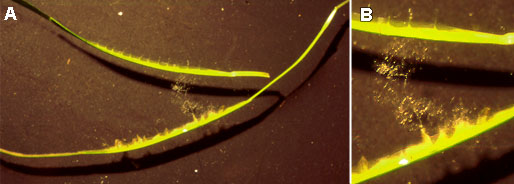
The most striking effect of both long- and short-term water deficit was to reduce pollen viability measured with the fluorochromatic assay. This was not an artefact of assay conditions. The pollen from water-stressed flower heads was not reversibly dehydrated; it did not score at similar viability to controls after incubation in conditions which hydrate pollen. In addition, the pollen from water-stressed plants lost viability more rapidly than pollen from well-watered plants after removal from the flower head.
The consequences of reduced pollen viability on seed set were investigated by hand-crossing within and between groups of plants maintained for several weeks at three levels of water supply. Flower heads pollinated with pollen from water-stressed plants set fewer seeds per floret than those pollinated with control pollen.
taken from www.jxb.oxfordjournals.org
Saturday, May 10, 2008
Amorous wasps 'seduced' by orchids
Orchids that mimic women wasps May not only wasting time men they attract wasps in their dissemination of pollen - they also appeal to lose value in semen, Sydney researchers have found.
And flowers benefit twice - get help in their own reproduction, and perhaps indirectly producing more men pollinators in the process.
Some of the more exotic orchids are known to have evolved their convoluted forms to attract insects, which unwittingly collect pollen and transfer as they try to mate with flowers.
"The effect of deception on pollinators was considered negligible, but we show that pollinators May suffer significant costs," Anne Gaskett of Macquarie University in Sydney and his colleagues reported.
"The insect pollinators language Australian orchids (Cryptostylis species) ejaculate often copious and waste sperm," they wrote in a report of The American Naturalist.
It is not safe for Wasps, who suffered May over a disadvantage. "Men prefer pollinators may orchids real women, prematurely terminated a copulation with a real women to visit an orchid, or may not be able to find women among the latter false signals of orchids," wrote researchers .
"Undoubtedly, the production of semen, ejaculate, or seminal fluid is expensive for many animals. The energy demand of sperm production can lead to a reduction in body mass, a life reduced lifespan limited or sperm production, "they added.
But this arms race sexual trickery operates in more than one way of the flower. "We also show that orchid species to cause such extreme behaviour of pollinators have the highest pollination success," they added.
"How can deception persist, given the costs of pollination?"
They discovered that the wasps who attend these flowers are haplodiploid species. Like bees, ants and other species, the offspring produced by sexual unions are women, while females may also produce men asexual.
"Therefore, deprived of insects mating by deception orchid could still produce male offspring, which May or improve pollination of orchids," wrote the researchers.
Ms. Gaskett the team examined the flowers after visiting wasps and found the men not fool finally learn their lesson.
"With experience, men Lissopimpla excelsa wasps are less likely to copulate with pollination and sexually Cryptostylis orchids misleading," they wrote.

