Showing posts with label Pollination. Show all posts

Wednesday, December 4, 2013

pollinated hybrid


Before discussing the various pollination , it never hurts to know what it is pollinated . Pollination ( pollinatio ) is the fall of pollen on the stigma ( for a closed group seed plants ) or fall pollen directly on the ovule ( for the naked seed plants ) . Pollination synonymous with fertilization . Pembuhan is the marriage ( being the union or pelemburan ) egg cells contained in the biological institute in the ovule with a core derived from pollen .

Based on the origin of pollen that fell on the stigma , pollination can be divided into several types, namely :
a. self-pollinating
Self-pollination is often called autogamy if pollen falls on the stigma comes from the flower itself .

b . pollination neighbors
Neighbor pollination or geitonogamy is often called pollination occurs when pollen falls on the stigma of another flower comes from the same plant .

c . cross pollination
Cross-pollination ( allogamy , xenogamy ) is pollination occurs when pollen falls into the stigma comes from the flowers of other plants , but still belong to the same type .

d . pollination hybrid
Hybrid or hybridogamy pollination is pollination occurs when pollen falls on the stigma comes from another flower on a different plant species, or at least have a different nature .

Well that's 4 kinds of pollination by native pollen falling on the stigma .


Sunday, December 1, 2013

Pollination by means of water


Pollination by means of water (called hidrogami)

Water-mediated pollination is pollination that occurs because of the help of water. In this pollination, water helps pollen falls upon the stigma. Water-mediated pollination occurs in plants that live in water, for example Hydrilla.


Spermatophyta


Plant the seeds of Spermatophyta (Greek, seed = seed, Phyton = plant) is a group of plants that items, namely the body in the form of seeds. Seed is part of the ovule and stopped at a new candidate each item, namely the institution. The Institute will take place after fertilization or pollination followed by characteristics of the seed body characteristics, including size, shape, structure, and function of the body.
The size and shape of the plant seeds macroscopic body size vary in height. The highest seed plant tree with a height of over 100 m. Sequoiadendron giganteum d konifeerbome of Yosemite National Park, California, with the benefits of 115 m height and a diameter of about 14 m. Habit or stature various plant seeds, trees, such as wood, Duku, coconut, banyan, fir, Perduk, such as roses, peacock flower, hibiscus, shrubs, herbs and fruit strawberries, lilies and purslane flowers.

Structure and function ...


Plant seeds heterospora . Plant seeds and set up a structure megasporangia mikrosporangia collected in a short sumbuh . For example , structures such as cone or strobilus on conifers and flowers on the flowering plants . As in other plants , spores of seed plants produced by meiosis in sporangia . But in plant seeds , megaspores is not removed , but retained . Megasporangia the development of the female gametophyte support and food and water supply . Female gametophyte in the sporangium remain matures and sporofit memlihara next generation after fertilization . In mikrosporangium , meiosis micro product . Micro tracks sporofit reach the formation of the pollen that grow in the direction toward the ovule the female gametophyte to fertilize germinate . In seed plants , the term micro is the pollen, a pollen sac mikrosporangium and mikrosporofil is benangsari . The term is a biological Institute megaspore ( embryo sac ) , megasporangium an ovule and megasporofil a carpels ( karpela ) .Way of life and reproductive habitat

Thursday, May 19, 2011

Pollination


Pollination can occur with different intermediaries:
a. Broker-called anemogami wind, can occur when the grain powder is very light, small and dry.
Example: on the pine, resin, grass.
b. Broker-called hidrogami water.

Example: on the water plant.
c. Broker-called zoogami animals.


* If an insect called entomogami
* Bird called ornitogami
* Snail called malakogami
* Bats called kiroptorogami


d. Human intermediaries called antropogami.
Example: pollination vanilli in Indonesia.


According to the origin of pollen, pollination can be divided into 4:
a. Autogami (self-pollinating)

Pollen from one flower the same. If there is not yet blooming flowers at the time called kleistogami.
b. Geitonogami (neighbor pollination)
When pollen from other flowers that are in one tree (one individual).
c. Alogami (cross pollination)

When pollen from the flowers of other trees are still one species.


Sometimes there is a failure of pollination and in some plant species are not possible autogami. The reason is as follows:
a. Dikogami: When the cook pistil and pollen does not coincide, and this is because:

* 1. Ripe pollen precedence over putiknya .... (Protandri). Example: celery, onion, corn
* 2. Pistils ripe pollen precedence over .... (Protogini).


b. Didesious: When in one species, male and female genitalia separate
Example: The bark and melinjo (Gnetum Arremon)


c.
Heterostili: If the length of the stalk stalk stamen
and pistil are not the same and different.
Examples: coffee, quinine and glass plates.

d. Herkogami: If the form does not allow flower pollen falls into the stigma.
Example: vanilla


Pollination and Fertilization Process
Grain dust / pollen on the stigma attached Þ Þ reed powder form (2 core, core nucleus of vegetative and generative) walking toward the micropyle (
the door of the biological institute) generative nucleus divides Þ Þ Þ 2 core sperm to the micropyle, dead vegetative nucleus Þ one sperm to fertilize the egg nucleus Þ embryo. The other sperm nucleus fertilize the biological core Þ institutions endosperm (food reserves for the embryo).

Since conception, the conception took place twice at Angiospermae called double fertilization.

Embryos in certain seed plants can be formed for several reasons. namely:


1. Through the fusion of sperm and ovum (amfimiksis)
2. Not through the fusion of sperm and ovum (apomiksis), which can be divided into:
a. Apogami: embryo formed from the biological institute. For example: from sinergid and antipode.

b.Partenogenesis: embryo formed from cells that are not fertilized eggs.
c. Adventitious embryo: an embryo formed from cells nuselus, namel
y the addition to the biological institute.


Apomiksis and amfimiksis can occur simultaneously, will be formed more than one embryo in a seed, called poliembrioni.
This event is often found in jackfruit, citrus and mango.


(taken from gurungeblog.wordpress.com)

Tuesday, May 3, 2011

Pollination by Animals


In general, pollination by insects and other animals are more efficient than pollination by wind. Typically, pollination benefits the animal pollinator to provide him with nectar, and the benefits the plant by direct transfer pollen from one plant to the pistil of another plant. Angiosperm flowers are often highly adapted to pollination by insects and other animals.


Each taxonomic group of animals related pollinating flowers typically have certain characteristics. Therefore, one can often determine which animal species pollinates a certain flower studying the morphology, color, and smell the flowers. For example, some pure red flowers, red or almost pure, and very little odor. Birds serve, like hummingbirds as pollinators of most of the flowers, since birds have excellent vision in the red region of the spectrum, and relatively undeveloped sense of smell. Interestingly enough, Europe has no native pure red flowers and any bird pollinated flowers.


Some flowers smell very strong, but they are very dark color. The flowers are often pollinated by bats, which have very poor vision, are often active during the night, and who understand very well developed odor.

The flowers of many species of plants are marked with special ultraviolet absorbing pigments (flavonoids), which appear to direct the pollinator toward the pollen and nectar.


The pigments are invisible to humans and most animals, but bees' eyes have special ultraviolet photoreceptors that allow the bees to detect patterns and so pollinate the flowers.


( from various sources )


Saturday, December 20, 2008

How can plants attract pollinators?


How can plants attract pollinators?

Cycads found in central Australia rely on thrips for pollination. The thrips are attracted by the scent, which then use to manage insects for male and female cones. Photo: M Bulbert © Australian Museum.

Just provide nectar can not guarantee that insects will come to a facility or transferring pollen to pollen recipients of the same species. For this reason, plants use visual and olfactory cues to attract and direct insects.

The scent is an effective way to attract pollinators. For example, strongly scented flowers tend to be visited by beetles and flies, while bees and butterflies visit fragrant flowers. It is also an effective way to manage pollinators to the pollen receivers.

Cycads from Australia internal use scent to lure thrips for pollination. Thrips are very small insects that can not carry much pollen grains, so the plant needs to attract a large number of them. A male Cycad cone laden with pollen will send a strong and pungent scent that will attract as many as 50 000 thrips. Female cones also emit an odor when they are ready to receive pollen, which then attracts the pollen-laden thrips.

Scent can also be used to fool the insects to be pollinators. The Corpse Flower of Indonesia uses a pungent smell of rotting meat to attract insects Carrión. The Australian Broad-lipped Orchid mimic the smell and also the emergence of a female Thynine wasps. This idiots male wasps in trying to mate with the flower that is pollinated in the process. www.bugwise.net.au

How does flower shape affect pollinators?


How does flower shape affect pollinators?

A bee using its long tongue (Silhouette through the side of the flower) to access the nectar at the base of a flower with a long tubular head. Photo: © M Batley.

Flower form can restrict access to pollen and nectar for only the insects that have the right tools or skills. For example, the nectar at the bottom of a long tubular flower can only be accessed by insects, which have long mouthparts, such as butterflies, moths, flies and bees, which have long-lapping 'tongues'.

The flower shape can be so limiting, to a certain type of behavior may be required for access to pollen. For example, "Buzz pollination" is needed to pollinate many Hibberta species. It is practiced by the blue striped Bee and a number of native Australian carpenter bees, and includes bee farm on the site and vibrating the pollen out.

The relationship between flower shape and location of nectar is also used by plants to attract certain insects. Many legumes (eg Luzern), has hidden nectar, which can be opened only by big, strong bees like Leaf Cutter or Resin Bees. The flowers of these plants are closed. It is only by pushing down on the lower parts of the flower that opens up to allow access to the nectar. As spring flower pollen is flung open to taking body of bees. www.bugwise.net.au

Pollination of nectar feeders


Pollination of nectar feeders

A bee is based on hidden anthers as the lives of nectar. Photo: © D Nelson.

Most of flowering plants to encourage insects to visit their flowers at a secret sugar-rich liquid called nectar. This nectar collects in pools, which is below the sexual organs of the plant. As insects into the flower in search of nectar, it brushes against the anthers (pollen-bearing male parts of the flower). In doing so the insect collecting pollen when it sticks to her body. When the insect visits another flower for more nectar, the pollen is moved from his body to Stamford (pollen receiving female parts of the flower), causing pollination.

Pollination of a nectar feeder has a range of potential benefits, including:

  • The location of nectar ensure insect can not avoid touching the bodies associated with pollination.
  • Pure nectar feeders such as butterflies and moths do not eat pollen.
www.bugwise.net.au

How can insects pollinate plants?


How can insects pollinate plants?
Pollination of pollen-feeder

A beetle collect pollen on her body as it feeds. Photo: © D Nelson.

Many insects eat pollen. In the process of eating becomes the subject of it. Pollination occurs when the pollen feeder transfer pollen to pollen recipients of the same plant or another plant of the same nature as insect look for more pollen to eat.

Drawbacks of attracting a pollen feeder:

  • Eating too much postal facility want delivered - pollen.
  • They tend to be general feeders and eat other parts of the plant, including sexual organs.
  • They can be regarded as' unreliable pollinators' as a pollinator can not go anywhere near the female organs of the same species of plant.
www.bugwise.net.au

Why is pollination by insects important

A fly resting on the anthers as it uses the sponge-like mouthparts to absorb the nectar. Photo: © O Batley.
Why is pollination by insects important for the environment and us?

  1. Pollination by insects is a much more reliable and effective pollination mechanism than the chance of spreading.
  2. Pollination by insects provides plant community structures.
  3. Pollination by insects is particularly important for Australian native trees and shrubs. For example, native bees pollinate many members of plant families Myrtaceae. This family includes eucalypts, angophoras and tea trees.
  4. Pollination by insects are essential for crop production. A third of the human food supply are crops that are dependent on pollination by bees.

What insects are pollinators?

Species of bees, beetles, flies, wasps, thrips, butterflies and moths are all successful pollinators.

These insects make good pollinators, because they share two important features:

* The flies, and are therefore able to visit many plants in a relatively short time,
* They are motivated to interact with pollen as they either eat it or food adjacent (eg nectar).

The most sophisticated relationship between plants and insects are generally those involving bees. The bees collect pollen and nectar, not only for itself but also to feed their young. For this reason, bees have developed a number of adaptations that make them particularly good pollen carriers. Bees have special hairs, which are designed to provide pollen 'curve' on their hindlegs and the underside of their abdomen. These adjustments will allow them to collect and transport large quantities of pollen. Bees are ideal pollinators because they visit many flowers, while carrying lots of pollen, before returning to their nest. So the chance that a bee will transfer pollen between flowers of the same species is very high.

Pollination by insect


What is pollination?

A leaf cutter bee manages to cover itself in pollen. Photo: © D Nelson.

Pollen is made of the male organs of a plant (anthers of flowers) and contains the genetic information necessary for plant reproduction. Pollination is the supply of pollen to the female organs of a plant (the parent of flowers).

Pollen can be transferred to the female organs at the same plant (self-pollination) or a second plant of the same species (cross-pollination). As a result of the pollination of plants produce seeds. Pollen can be spread by wind, water and animal pollinators such as insects, bats and birds.

How important is insect pollination?

It is estimated that 65% of all flowering plants and some seed plants (eg Cycads and Pines) require insects for pollination. This percentage is even greater for economically important crops that give fruits, vegetables, textile fiber and related products. Because the insects are as effective pollinators, plants have developed many ways to encourage them to visit. This has led to some strong associations between plants and insects. www.bugwise.net.au

Pollination of plants by insects


by Rudy SCHEIBNER,
Extension Entomologist

Pollination is a process by which plants receive pollen from other plants of the same species, so they can reproduce by forming seeds. Some plants are pollinated by the wind, and some are pollinated by insects or other small animals. When the plants are pollinated by insects, it looks like some kind of agreement was reached, after which the facility will provide insect with anything, if insect will pollinate the plant flowers in return. Although the plant and the insect can take advantage because of their connection to each other, the insect visits a flower usually not targeted pollinate the flower.

Honey Bees are very important insect pollinators. Most of the time, both honey bees and the plants they visit, is beneficial. The honey bee get some food and equipment get pollinated. When a honey bees collect pollen from the anthers (male reproductive part) of a flower, it brings the pollen in special pollen baskets on its hind legs. All that pollen will be taken back to the hive of bees' use. The honey bees is a messy producer of food, and some pollen gets stuck on the hairs of her body. When bien visit the next flower, some of the pollen brushes off the flower, and if it sticks to the stigma (female part) of the flower, pollination will take place. Bien does not make any effort to put the pollen in the right place.

Bees also collect pollen from corn, grain but gets nothing in return. Corn is pollinated by the wind. When honey bees try to get nectar from a flower alfalfa, the flower has a tripping device, which merges the bees in the face with one, too (the pollen-bearing part of a flower). It is the flower on the way to ensure that its pollen being attached to an insect to transfer to another flower. Bees do not like being slapped in the face, so they usually find some other kind of plant to get nectar. Some of the bees learn to chew a hole in the side of the flower and get to the nectar through the side door. When they do that pollination occurs not because the pollen on the bees do not reach the top of stigma. So it seems that the only reason for a bee visit a flower is to get what it wants and not to perform a pollination service. Pollination occurs as a happy accident of the flower.

Many other kinds of insects as wasps, flies, beetles, thrips and other types of bees, feeding on nectar or pollen also pollinate flowers by accident. However, there are at least some insects, who deliberately make sure that the flowers they visit get pollinated. The way a Yucca flower is built, it may not be pollinated in the ordinary way, and it depends on the special service of a Yucca moths to do it. When the moths come to a Yucca flower assemble a ball of pollen, and then goes to the ovaries of the female part of the flower, where it includes some eggs. Then rises to the top of the female part of the flower and puts the ball of pollen on the stigma where it is due for pollination to occur.

Now that it is pollinated, the flower can produce seeds in her ovary. The Yucca moth larvae eat some of the seeds, but many are left over to produce new Yucca plant. Because Yucca moth larvae eat only Yucca seed, and Yucca plant is pollinated only by Yucca moths, both moth and the plant will depend on each other for survival. www.uky.edu

( The image from www.landcareresearch.co.nz)

Saturday, November 22, 2008

Bees as Desert Plant Pollinators They’re not all honey bees


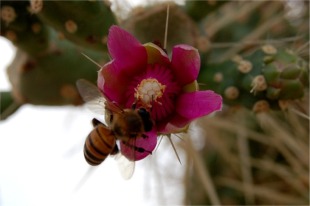
Ever wonder how plants in the desert get pollinated? Although there aren't a great amount of honeybees in desert areas, there are many species of native bees that live in arid regions.

“Pollen” bees, also called native or solitary bees, are the main pollinators of plants in the world. They tend to be out and active in the early spring, before honey bees (which were imported to the Americas from Europe), and are very efficient pollinators.

Honeybees, which are also great pollinators, are generally raised for honey, while pollination is a byproduct.

In recent years, both native bee species and honeybee populations have been decimated because of the Varroa mite, and because of pesticides and habitat destruction.

Extensive use of pesticides, not only on farmland, but also in suburbia, has had a serious effect on all types of bees. It’s not widely known, but even natural herbicides and botanical pesticides can cause serious harm to bees.

Besides honeybees, and Africanized bees (simply another, albeit more aggressive strain of the domestic honeybee), there are a number of greatly beneficial native bees.

Digger bees, mining bees and sand bees are solitary ground-nesting bees.

Bumblebees, on the other hand, are social creatures.

Sweat bees are small, blackish or brownish bees, although a few species are greenish. As the name implies, they will sometimes land on your arm or neck to sip sweat. They are gentle and will not sting unless you swat them.

Alkali bees are native to the North America west of the Rocky Mountains. They are solitary and are black, with metallic-looking bands of yellow, blue or green circling the abdomen. They pollinate alfalfa, onions, clover, mind and celery.

Leafcutter bees are extraordinarily efficient pollinators. About 150 of them can do the pollination work of 3,000 honeybees.

Carpenter bees are some of the largest bees in the world. They can range in color from blue-black, purple or a greenish sheen. They drill circular holes in wood, and can tend to be annoying because of their tendency to buzz around. They are, however, generally harmless. The females do have a stinger, but they rarely use it.

Certain types of flowers attract all species of bees more than other types of flowers. Flowers which bees find particularly attractive include those that are:

  • Full of nectar
  • Since bees cannot see the color red, flowers that have petals that are brightly-colored and generally blue or yellow, or a mixture of these two colors.
  • Aromatic or minty smell.
  • Open in daylight
  • Have platforms upon which the bees can land
  • Generally symmetrical bilaterally
  • Can be tubular with nectar at the base.

Related articles:

  1. How Desert Plants Get Pollinated
  2. Bats Pollinate Desert Plants
  3. Hummingbirds as Desert Pollinators

The copyright of the article Bees as Desert Plant Pollinators in Desert Gardens is owned by Robert Dailey. Permission to republish Bees as Desert Plant Pollinators in print or online must be granted by the author in writing. www.desertgarden.suite101.com

the image from www.edupic.net
Thursday, November 20, 2008

Desert Lupine


he desert lupine is native to the Mojave, the desert in California and Nevada and New Mexico, Arizona and parts of Texas.

It does not like higher altitudes, but will grow along the roads in the desert and on slopes, and even the tops of Mesa.

It has a bright blue flower, which can be blue, purple or violet, and it is high on a small upright stems. Petals have a yellow spot, which will switch to red when the plant has been pollinated.

The upper petal is called a banner petal while the two lower them called the keel. They have hair on the bottom and curves up a little.

The bears seed pods, which when ripe will blow up, and the seeds explode everywhere and scatter on the wind.

Blue, 1/2-inch wide blue to purple flowers bloom on slender, up STALKS January through May.

The upper petal (banner) has a yellow spot the changes of reddish after pollination. The two lower petals (keel) is short and long, and are hairy on the bottom edge and curve upward to a slender tip. When mature, seed pods explode, scattering their seeds to the wind.

This flower is called an annual which means that the door completely and seeds to grow new plants.

Desert lupine will completely cover an area where it has been a rainy year, and even when it does not have the lupine will or other compensation, and they will be plentiful in the deserts of the Southwest.

Bees are drawn to the lupine, and it again depends on them to pollinate it. (www.isnature.org)

Pollination by Deception


A male thynnine WAsP (Neozeleboria cryptoides) attempts to mate with the flower of a broad lipped bird Orchid (Chiloglottis trapeziformis). Photo by Rod Peakall.

A male thynnine WAsP (Neozeleboria cryptoides) attempts to mate with an Orchid flower (Chiloglottis trapeziformis). Photo Rod Peakall. Pollinator are attracted two plants that appear to provide a reward. Most often, the Pollinator does receive a reward, such as food or shelter for the growing young. But looks (and Scents) can be Deceiving. Some plants attract Pollinator with deceptive cues such that pollination is achieved for the plant but the Pollinator gets nothing in return. Well-known examples of pollination by deception involve Orchid and the Wasp and other insects that pollinate them. Some Orchid flowers attract male insects by mimicking the odore and appearance of female insects. Males attempt to mate with one flower, and then another, transferring pollen among flowers in the process.

Though some Orchid flowers closely resemble the appearance of females of the primary pollinating species, odore may be the most important cue. In at least some cases, the odore compound emitted by the Orchid is identical to the female sex pheromone emitted by the Pollinator species (Reference: pollination by Sexual Deception in Australian Terrestrial Orchid, Rod Peakall, Australian National University, 2007). Other Orchid Mimic the Pollinator 'food plants. For example, the southern African Orchid Disperis capensis produces flowers that closely resemble those of another plant, Polygala bracteolata. Bees pollinating P. bracteolata (which does provide a food reward) inadvertently pollinate the look-alike as well. What appears to be another twist Wednesday pollination by deception was documented recently. Malaysian dung Beetles of the genus Onthophagus (Family: Scarabaeidae) are the major Pollinator of Orchidantha inouei, a plant related to ginger, bananas, and bird-of-paradise plants. The flowers of O. inouei appear to attract the Beetles by emitting a dung-like (ie food) odore, but do not provide any food reward or protected space for the Beetle.
Pollination of Deception

A male thynnine wasp (Neozeleboria cryptoides) attempt to mate with the flower of a broad lipped bird orchid (Chiloglottis trapeziformis). Photo by Rod Peakall.
A male thynnine wasp (Neozeleboria cryptoides) attempt to mate with an orchid flower (Chiloglottis trapeziformis). Photo Rod Peakall.

Pollinators are attracted to plants that seem to offer a reward. Usually, the pollinator not receive a reward, such as food or shelter for the cultivation of young people. But look (and odors) can be deceiving. Some plants attract pollinators with misleading cues such that pollination is achieved for the plant, but the pollinator gets nothing in return.

Well-known examples of pollination by deception involving orchids and wasps and other insects that pollinate them. Some orchid flowers attract male insects by mimicking the smell and appearance of female insects. Males try to mate with a flower, and then another, the transfer of pollen among flowers in the process. Although some orchid flowers closely resemble the presence of females of the primary pollinating species, odors may be the main headline. At least in some cases, the odor compound emitted by the orchid is identical to the female sex pheromone emitted by pollinator species (Reference: pollination by sexual Deception in Australian Terrestrial Orchids, Rod Peakall, Australian National University, 2007).

Other orchids mimic the pollinators' food plants. For example, the South African orchid Disperis capensis produces flowers that closely resemble those of another plant, Polygala bracteolata. Bees pollinating P. bracteolata (giving a food reward) inadvertently pollinate the look-alike as well.

What seems to be another twist on pollination by deception was proved recently. Malaysian fertilizer beetles of the genus Onthophagus (Family: Scarabaeidae) is the most important pollinators of Orchidantha inouei, a plant related to ginger, bananas, and bird-of-paradise plants. The flowers of O. inouei seem to attract the beetles, which emits a dung-like (ie food) smell, but do not provide any food reward or protected space for the beetle.

from www.nbii.gov