The flowers are known for attracting insect pollinators, through a variety of means, perfumes and attractive to nectar colors and shapes. According to a new study in the Journal of Evolutionary Biology, scientists can now add a mechanism unlikely the list: the movement. Researchers at the University of Aberystwyth in Wales observed coastal 300 flowers, noting stem length, the range of swinging distance, how often and for how long they were visited by insects, and the number seeds were produced in the end.
These flowers with long slender stems proved to be most attractive to insects and produces most of the seeds. Researchers have concluded their proposals to move the most visible among others. There are practical limits, however. These flower stems too terribly long moved to enable insects to make a landing stable and are generally avoided. Similarly, the flowers with shorter stalks are less visited because they were difficult to differentiate from the crowd.
Friday, May 9, 2008
New Study: Flowers Attract Insects with Movement

Pollination
Orchids have developed highly specialized systems pollination and therefore likely to be pollinated are often scarce. That is why flowers of orchids are generally very receptive to long periods and why most orchids provide pollen in a single mass, whenever succeeds pollination of thousands of eggs can be fertilized.
Pollinators are often visually attracted by the shape and colors of the labellum. The flowers produce attractive May odors. Although the absence in most species, May nectar produced in a fork (8) labellum, on the verge of sepals or in the septum of the ovary, the most typical position among the Asparagales.
In orchids that produce pollinia, pollination happens as a variant of what follows. When the pollinator entry into the flower, it affects a viscidium, which quickly sticks to his body, usually on the head or abdomen. While leaving the flower, he pulls the pollinium of anthers, as it is connected to the viscidium by the caudicle or stipe. The caudicle then turns and the pollinium is moved forward and down. When pollinators entering a flower of the same species, pollinium took this position it will stick to the stigma of the second flower, just below the rostellum, pollination. Holders of orchids May be able to replicate the process with a pencil or a similar device.
Ophrys apifera is on the verge of self-pollination
Ophrys apifera is on the verge of self-pollination
Some orchids mainly or wholly rely on self-pollination, especially in cold regions where pollinators are particularly scarce. The caudicles May dry up if the flower has not been visited by a pollinator and Pollina then fall directly on the stigma. Otherwise, the anther May turn and then enter the stigma cavity of the flower (as in Holcoglossum amesianum).
The labellum of the Cypripedioideae is shaped pocket and a function of access to trap insects. The only exit led to anther that the deposit pollen on the visitor.
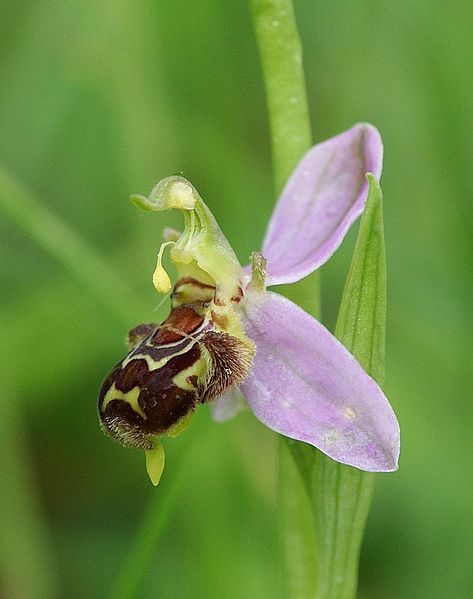
In some orchids very specialized, like the kind Ophrys Eurasian, the labellum is adapted to have a color, shape and odor that attracts insects males mimic a receptive female. The pollination happens as the insect attempts to mate with flowers.
Many neotropical orchids are pollinated by bees male orchid, which visit flowers to collect volatile chemicals they need to synthesize pheromonal attractive. Each type of orchid pollinia place on another part of the body of another species of bee, so as to apply a good cross-pollination.
An underground orchid in Australia, Rhizanthella slateri, ever see the light of day and depends on ants and other insects land for pollination.
Catasetum, a kind briefly discussed Darwin actually launches its viscous pollinia with explosive force when an insect touches a seta.
After pollination sepals and petals wilt and disappear, but they generally remain committed to the ovary.
Flowers "wave" of insects to attract their attention, scientists have discovered.
Flowers "wave" of insects to attract their attention, scientists have discovered. The finding helps explain why many flowers waft in the breeze, and reveals something unknown hitherto used to attract pollinators. The scientists made the discovery by studying wildflowers common known as sea campion on the Welsh coast. Mobile flowers are most often visited by insects and produce more seeds, they report in the Journal of Evolutionary Biology.
Moving flowers also attract a wider variety of insect species that flowers more static. For years, biologists have known that the flowers use striking colours, perfumes, developed shaped petals and nectar to attract pollinating insects like bees and flies. Yet, nobody had ever seriously considered if wafting in the wind acted as a similar signal.
Seaside inspiration "I was on the beach watching the flowers wave in the wind at my daughter's birthday, and I wondered why they have stems and may have damaged during a presentation of these habitats" said John Warren of the University of Aberystwyth.
He therefore sought that research has already been done, and we found very few answers. "The only reference I found the movement to attract pollinators said it was unlikely to be significant because the insects are not good at detecting movement, which is clearly rubbish." To learn more, Dr. Warren and James Penri experienced colleague on Wednesday Campion (Silene maritima) more and more on an exposed coast in a site of special scientific interest in Cardigan Bay in west Wales.
They observed 300 specially developed flowers of different lengths of stem, recording how much each flower moved the wind, how often it has been visited by insects and for how long and how many seeds it has to produce.

