This is the type of Cactus diverse. there are many types of cactus that can we find in this world
Showing posts with label desert flowers. Show all posts
Showing posts with label desert flowers. Show all posts
Saturday, December 13, 2008
DIVERSE OF CACTUS

CACTUS
Cactus comes from the Greek word kaktos. This means that the thorny plants. Linneaus is, botanist who created the classification of plants, the cactus to enter in groups or thorny plants, Cactaceae.
When referring to the history, cactus has been growing about 100 million years ago. Previously cactus form of a body high. Then, around 60 million years later, cactus declared extinct. This occurred due to volcanic eruptions that took drown Continent United States, which Unsurprisingly place to grow.
After vulkanik volcanic activity is stopped, cactus to grow back. However, cactus-generation "Anyar" grow with this form of a short moyangnya from yesterday. Short form of cactus that we often met in the present time.
Generally, the cactus came from the barren plains, such as South America and Mexico. Areas that have low rainfall, with a frequency that is not necessarily. Changes in temperature are also very extreme. There is also the opinion that the cactus is derived from Central and South America, Canada to the North until the Galapagos Islands, in the tropical Pacific Islands and in East India and the Caribbean.
Regional cactus is a diverse life. From the coastal region that leads to the sea, forest wilderness to the mountain range of ice berbalut the Andes Mountains. So, this is not strange when met at the height of cactus 3000 - 4000 m above sea level.
From the fact was, can be included cactus plants which can survive in any field. Cactus easily make adjustments and forms of adaptation in the body. "An example of this adaptation can be clearly seen. When the natural conditions are not suitable, cactus leaf size will be reduced or even not at all out of the leaves. Perakarannya stem be tighten and the storage of water, "said Joesi that since primary school is interested in the cactus.
While in the regions with hot and arid land, cactus adapting to establish how the body skin and thick layer of wax. No lag, hair-growing fuzz or thorn-sharp thorns. Functions clear, reduce the expenditure of the water body.
In the case of the spread, bird players meritorious fruit cactus is considered to sow the seeds of all the places in the world. Although so, people still recognized as a major factor in the distribution of two users of this plant. It can be seen when they perform a migration, cactus never behind in the list of default.
Examples of the most easy, the spread of the cactus in their own country. In Indonesia, cactus entry through the hands of government the Dutch colony. Bule-thing original state windmill is the first to the seeds and cactus. "When the Dutch government, cactus spread to various areas (in the archipelago)," said Joesi.
Habits involve cactus to a new place also made Joesi. "Because my father often switch tasks, cactus collection dibawa.Tapi families often participate because of too many, there is also a deliberately abandoned," he said.

Saturday, November 22, 2008
Bees as Desert Plant Pollinators They’re not all honey bees
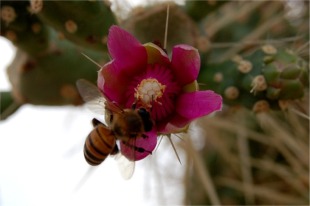
Ever wonder how plants in the desert get pollinated? Although there aren't a great amount of honeybees in desert areas, there are many species of native bees that live in arid regions.
“Pollen” bees, also called native or solitary bees, are the main pollinators of plants in the world. They tend to be out and active in the early spring, before honey bees (which were imported to the Americas from Europe), and are very efficient pollinators.
Honeybees, which are also great pollinators, are generally raised for honey, while pollination is a byproduct.
In recent years, both native bee species and honeybee populations have been decimated because of the Varroa mite, and because of pesticides and habitat destruction.
Extensive use of pesticides, not only on farmland, but also in suburbia, has had a serious effect on all types of bees. It’s not widely known, but even natural herbicides and botanical pesticides can cause serious harm to bees.
Besides honeybees, and Africanized bees (simply another, albeit more aggressive strain of the domestic honeybee), there are a number of greatly beneficial native bees.
Digger bees, mining bees and sand bees are solitary ground-nesting bees.
Bumblebees, on the other hand, are social creatures.
Sweat bees are small, blackish or brownish bees, although a few species are greenish. As the name implies, they will sometimes land on your arm or neck to sip sweat. They are gentle and will not sting unless you swat them.
Alkali bees are native to the North America west of the Rocky Mountains. They are solitary and are black, with metallic-looking bands of yellow, blue or green circling the abdomen. They pollinate alfalfa, onions, clover, mind and celery.
Leafcutter bees are extraordinarily efficient pollinators. About 150 of them can do the pollination work of 3,000 honeybees.
Carpenter bees are some of the largest bees in the world. They can range in color from blue-black, purple or a greenish sheen. They drill circular holes in wood, and can tend to be annoying because of their tendency to buzz around. They are, however, generally harmless. The females do have a stinger, but they rarely use it.
Certain types of flowers attract all species of bees more than other types of flowers. Flowers which bees find particularly attractive include those that are:
- Full of nectar
- Since bees cannot see the color red, flowers that have petals that are brightly-colored and generally blue or yellow, or a mixture of these two colors.
- Aromatic or minty smell.
- Open in daylight
- Have platforms upon which the bees can land
- Generally symmetrical bilaterally
- Can be tubular with nectar at the base.
Related articles:
The copyright of the article Bees as Desert Plant Pollinators in Desert Gardens is owned by Robert Dailey. Permission to republish Bees as Desert Plant Pollinators in print or online must be granted by the author in writing. www.desertgarden.suite101.com
the image from www.edupic.net
the image from www.edupic.net
Thursday, November 20, 2008
Desert Lupine
he desert lupine is native to the Mojave, the desert in California and Nevada and New Mexico, Arizona and parts of Texas.
It does not like higher altitudes, but will grow along the roads in the desert and on slopes, and even the tops of Mesa.
It has a bright blue flower, which can be blue, purple or violet, and it is high on a small upright stems. Petals have a yellow spot, which will switch to red when the plant has been pollinated.
The upper petal is called a banner petal while the two lower them called the keel. They have hair on the bottom and curves up a little.
The bears seed pods, which when ripe will blow up, and the seeds explode everywhere and scatter on the wind.
Blue, 1/2-inch wide blue to purple flowers bloom on slender, up STALKS January through May.
The upper petal (banner) has a yellow spot the changes of reddish after pollination. The two lower petals (keel) is short and long, and are hairy on the bottom edge and curve upward to a slender tip. When mature, seed pods explode, scattering their seeds to the wind.
This flower is called an annual which means that the door completely and seeds to grow new plants.
Desert lupine will completely cover an area where it has been a rainy year, and even when it does not have the lupine will or other compensation, and they will be plentiful in the deserts of the Southwest.
Bees are drawn to the lupine, and it again depends on them to pollinate it. (www.isnature.org)

Subscribe to:
Posts (Atom)
